
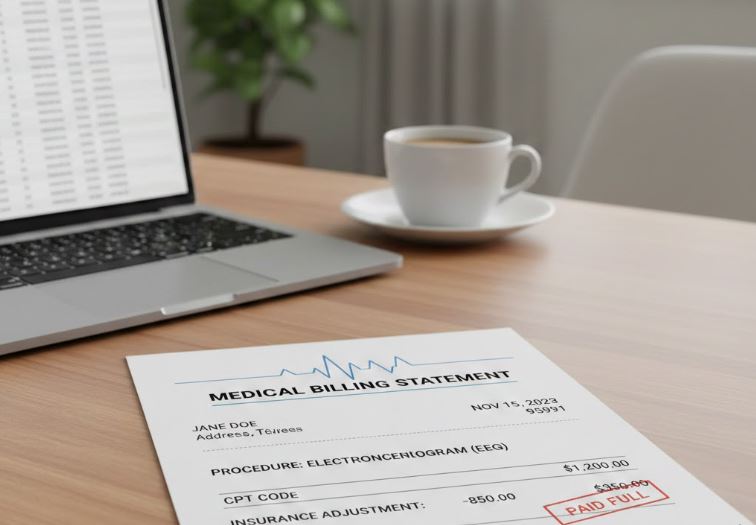
Things to Consider in Neurology billing for EEGs

EEG Billing

Diagnosis and billing are integral parts of any medical speciality that cannot provide satisfactory results without precise handling. Neurology services cover multiple diagnostic processes to monitor better mental health. EEG is one of the diagnostic tests. It uses electrode discs to monitor the electrical activity of brain cells. Specialists use this test to identify major neurological disorders. Due to the indispensable clinical value of EEG, their billing practices should be error-free and compliant. 

An accurate and thoughtful billing claims escalation boosts financial stability by ensuring fair reimbursement. However, getting perfection in billing claims is difficult, demanding efficient navigation through coding and insurance verification. Practices face several challenges with EEGs billing, such as accurate coding with correct modifiers and timely claims submission. This article covers all possible aspects of EEG billing for neurology services, highlighting important modifiers to remember, common committed mistakes, and best practices to stay safe. 

Understanding EEG Billing & CPT Codes

What is EEG Billing?

EEG billing covers all the steps and processes a billing team performs to submit a compliant claim and successful reimbursement for an electroencephalogram test. EEGs are highly critical tools due to their electrical characteristics and complex use. Therefore, billing teams need additional care while applying CPT codes for EEG. The billing process for neurology EEG does not end with simple diagnosis but imposes several further challenges when the test is performed partially or more than once for an accurate report.

 In this case, small codes (modifiers) support CPT codes for clear explanations. EEG can diversify its duration from short to prolonged monitoring in complex mental states. A billing practice selects the correct CPT code for complicated tests, prepares all required medical documents to prove the test’s necessity, and applies modifiers for incomplete services. All these steps work collectively to give a healthy cash flow for neurology practices.

Key CPT Codes for EEGs

Here is the list of most commonly used CPT codes that help in successful reimbursement for routine tests or long-term follow-ups: 

95812 – Routine EEG, less than 24 hours

This specific code is used for patients who receive their EEG diagnosis service in an outpatient setting. Such tests usually last less than 24 hours, so a claim request is also submitted for the party day.

95813 – Routine EEG, more than 41 minutes

In critical neurology disorders, professionals follow a lengthy procedure for more than 41 minutes. This test monitors the brain cells for a long time to prepare a better care plan. 

95816 – Routine EEG, 20–40 minutes

The code mentioned is mainly used in neurology EEG because it covers routine checkups that end in 20-40 minutes, and the patient stays conscious. It is the most frequently used code because neurologists perform it initially after finding the physical symptoms of neurological disorders. 

95819 – Routine EEG, awake and asleep monitoring

The code applies when EEG is performed in a single session, but the patient is awake and asleep. The test in both conditions helps to monitor the cells’ activity in the sleeping condition and their difference from the waking state. Such a test is essential to detect epilepsy and sleeping disorders.

95822 – EEG performed on a patient in a coma or asleep

This code applies when an EEG is performed for coma patients or when an individual stays asleep throughout the test. Critically brain-injured or unconscious patients are treated through this detailed EEG, such as those admitted to the ICU or emergency settings. 

Modifiers Used in EEG Billing

Neurology services demand interaction with multiple professionals, so a single CPT code cannot define reimbursement. Short two-digit codes help to explain who performed what part of patient care and whether the service is completed, stopped, or altered with more valuable options according to the patient’s recovery state. Most commonly used modifiers are as follows: 

Modifier 26 (Professional Component)

The modifier applies if only the professional part of neurology is used, such as a neurologist interpreting the need for an EEG or providing a report as a reference for conducting the diagnostic test. 

Modifier 52 (Reduced Services)

This modifier is used when an EEG procedure is started, but the technician has to stop it due to the patient’s lower tolerance. The service can also be partial due to clinical findings.

Modifier 95 (Telemedicine Services)

The modifier indicated that the patient consulted the results of performing an EEG through real-time audio or video communication with professionals. Due to the growing adoption of telehealth, modifier 95 has significant value.

Best Practices for EEG Billing

Although the billing process for EEG services is complicated, some consistent and thoughtful strategies can simplify the whole process. A few of them are as follows:

Ensuring Accurate Documentation

Clear and detailed documents are the first step in compliant billing claims in EEG reimbursement. In these documents, a practice should prepare records for physical neurological symptoms in patients further indicated for an EEG test. The date, time, and duration of the procedure are also essential to record to prepare a detailed document that prevents claim denials and unexpected audits.

Avoiding Common Coding Errors

EEG billing covers a wide range of codes and their modifiers, so a misinterpreted code is a common mistake in a claim. Sometimes, the billing team forgets to apply a modifier or mentions it for irrelevant reasons. All such pitfalls lead to denials; therefore, practices must train their staff for frequent internal audits.

Verifying Insurance Coverage & Pre-Authorization

In some cases, claims still face denial after having all the supporting documents and accurate coding. This occurs due to neglecting insurance verification and prior authorisation approval. Providers must ensure insurance coverage and communicate with payers before performing EEG tests, which can prevent later billing disputes.

Compliance with Medicare & Private Payer Guidelines

Medicare and private insurers can differ in their insurance rules, and their requirements for EEG billing can also be diverse. EEG providers must have updated knowledge about all payer guidelines, which helps manage records accordingly.

Using Electronic Health Records (EHR) for Efficiency

Manual handling in billing claims has a high chance of committing coding mistakes. Hence, practices should prefer EHR systems. These technology-based platforms offer auto-filling for CPT codes and detect errors in claims more efficiently.

Tools & Resources for EEG Billing

Knowing the correct codes and billing documentation is not enough for successful reimbursement; practices should know the latest tools and resources to stay ahead. A few valuable ideas are as follows:

Top EEG Billing Software

Automating and streamlining the EEG can save from manual errors, so practices must integrate their operation with modern EHR systems. For example, EpicCare EMR is a robust option for preparing neurology templates and auto-filling CPT codes. AdvancedMD is also the best, offering customisable and efficient neurology billing features with smart detection in billing claims. NextGen Healthcare helps reduce compliance errors while providing real-time knowledge about payer-specific demands.

Industry-Recognized Coding References

CPT codes and payer guidelines evolve suddenly, and their negligence can lead to potential financial loss. Neurology practices should stay updated with all minor to significant changes in coding criteria or documentation requirements. CPT code books published by the AMA can provide more accurate knowledge about this context. Billing teams must follow the guidelines issued by ICD-10, helping to stay compliant and avoid denials. Considering CMS regulations in detail also saves from sudden mistakes.

Neurology Billing Compliance Guidelines

Medicare and Medicaid guidelines for neurology services can differ, so practices should continually evaluate the patient’s insurance policy to understand the payer requirements. Thus, advance confirmation saves from later complications and helps maintain the record or apply the codes according to insurance providers’ instructions.

Training & Certification Programs

Due to the evolving nature of CPT codes and documentation requirements for EEG neurology billing, practices should invest in formal education and employee certification. This ongoing development helps staff understand the latest requirements and enables them to handle complex billing claims more efficiently. Getting a CPC certificate from AAPC or compliance training from AHIMA can polish the billing claim handling skills.

Final Analysis

This test guides neurologists in evaluating the actual stage of a neurology disorder that a patient’s physical examination cannot monitor. These EEG tests demand complicated tools and technology. Therefore, their billing claims are also not straightforward to fill in single settings. Service providers deal with numerous challenges and patients’ physical conditions. EEG demands an efficient billing handling for proper reimbursement of service providers, and it is possible only with thorough documentation and error-free coding.

Injection & Pain Management

We provide compliant billing for foot injections, nerve blocks, and pain management procedures with accurate documentation and proper modifier usage.

Advanced Treatments

We handle advanced podiatric treatments with proper prior authorization management and comprehensive clinical documentation for high-value services.

Nail & Skin Procedures

We ensure accurate coding for nail debridement, callus removal, and skin lesion treatments with proper medical necessity justification and frequency compliance.

Surgical Procedures

We manage complex podiatric surgeries with accurate modifier usage, justified gaps between claims, and transparent timeframe documentation for all procedures.

Diabetic Care Management

We coordinate diabetic foot care services with proper medical necessity documentation and systematic condition correlation for comprehensive treatment.

Orthotic Services

We provide specialized billing for custom orthotics and devices, ensuring proper HCPCS and ICD-10 code pairing to justify fitting and delivery documentation.

Routine Care & Diagnostics

We handle routine foot care according to strict medical necessity criteria, ensuring precise paperwork and accurate coding for debridement and mycotic nail care, with proper frequency documentation.

Wound Care Partnerships

We provide accurate code coordination to prevent overlapping, ensure transparent tracking for pre- and post-surgical services, and deliver complete operative notes with reduced errors.

Graft & Skin Substitute Procedures

We select accurate application and graft codes based on location and wound size, audit surgical documents to ensure correct Q-code pairing for procedures and supplies, and assist in navigating state-specific Medicaid nuances through proactive prior authorization.

DME Billing

Robust compliance for orthotics, diabetic shoes, walking boots, and offloading devices. We ensure that certified coders are used for accurate coding and a perfect match for every claim. We evaluate the signature requirements of every payer and employ proactive strategies for expedited prior authorization.

Injection Therapies

We handle foot injection procedures with accurate MCO compliance, ensuring proper documentation and modifier usage for maximum reimbursement in the NY market.

Nail & Skin Care

We provide compliant billing for nail debridement and skin lesion procedures, meeting eMedNY-specific documentation requirements and ensuring proper medical necessity justification.

Advanced Treatments

We manage advanced podiatric treatments with NY-specific requirements, ensuring proper Q-code usage, comprehensive clinical packets, and expedited prior authorization processes.

Diabetic Care Management

We coordinate diabetic foot care services with wound care partnerships, ensuring proper documentation and transparent billing coordination for all involved providers.

Surgical Procedures

We handle complex podiatric surgeries with MCO coordination, ensuring accurate service sequencing and proper documentation to prevent overlapping claims and denials.

Orthotic Services

We provide specialized eMedNY-compliant orthotic billing with precise HCPCS coding, accurate ICD-10 pairing, and comprehensive modifier knowledge for maximum reimbursement.

Routine Care & Diagnostics

We ensure eMedNY compliance for routine foot care services with systematic condition documentation, proper modifier alignment, and comprehensive medical necessity justification for all procedures.

Graft & Skin Substitute Procedures

We prepare comprehensive clinical packages for fast approval, ensure thorough compensation for graft products and application, and prevent claims denials through accurate coding and correct submission.

Wound Care Partnerships

We provide accurate code coordination to prevent overlapping, ensure transparent tracking for pre- and post-surgical services, and deliver complete operative notes with reduced errors.

DME Billing

NY Medicaid’s top coverages include diabetic shoes and inserts, ankle-foot orthoses, braces, and custom-molded orthotics. We ensure eMedNY compliance through precise documentation, proper ICD-10 coding, and in-depth knowledge of modifiers to prevent denials.

Robotic Procedures

We deal with complex billing for radical prostatectomy, partial nephrectomy, and cystectomy by elaborative documents for the used devices. Our accurate codes and modifiers ensure successful approvals.

Telehealth

Our coders ensure accuracy for pre-op consultations, follow-ups, and LUTS/OAB management. Our optimized POS and use of modifiers have lower denial rates, as we demonstrate their necessity with clinical documents.

Urodynamics & Diagnostics:

We handle multi-channel involvement and billing complications with detailed CPT/ICD pairing. Our proactive prior authorization handling and expert claim structuring ensure error-free approvals.

Cystoscopy & Endoscopy:

We capture every detail and require evidence to ensure a smooth claim approval for office-based and hospital-based endoscopic procedures. We offer robust billing claims for biopsies and stone removals.

Lithotripsy (ESWL) & Stone Management:

We understand the complex bundling of ESWL, URS, and stone procedures, including device charges, anesthesia, and supplies for ongoing care. This in-depth knowledge ensures coding accuracy for each component.

Prostate Procedures & Biopsy:

We offer meticulous billing for targeted biopsies and imaging-guided prostate procedures, ensuring proper coordination of involved pathology and detailed capture of all allowable charges.

Implants & Prosthetics

We strictly follow the payer’s rules for high-value penile prostheses and testicular implants, ensuring proper coverage for device charges. Our coders ensure proper coding pairs, transparent vendor contracts, and logs for implants.

Pathology & Imaging

Our team possesses in-depth knowledge of the working principles of pathology and imaging centers. We collaborate with service providers to obtain accurate clinical information, ensuring that we capture all allowable charges.

Botox & Neuromodulation

For these complex services, we provide thorough coverage by handling prior authorization approvals and ensuring coding accuracy for both trial and permanent procedures. Our modifier’s accuracy provides high compliance with diverse payer requirements.

DME & Catheter Supplies:

We provide streamlined billing claims for catheter and drainage bag supplies, ensuring smooth and timely payment collections. Our proof-of-delivery and proactive SOPs save practices from financial loss.

DME & Catheters

We handle catheter supplies, ongoing maintenance claims, and billing for incontinence aids. We complete clinical documents with proof of need, supply evidence, and other supporting elements according to Medicaid requirements.

Pathology & Advanced Imaging

Outpatient labs and imaging services face facility-based billing cuts due to poor classification. We manage all complexities with professional splits and ensure compliant claims for radiology reads and pathology services.

Botox & Neuromodulation

We perfectly align the trial with a permanent implant and explain all stages with accurate codes. Our precise and error-free claim submission ensures maximum reimbursement for all elements.

Implants & Prosthetics

We offer support for commercial or Medicaid billing claims through transparent device tracking, fair vendor contracts, and compliant pre-auths, resulting in the successful implantation of penile prostheses, urinary sphincters, or slings.

Prostate Procedures & Biopsies

Pairing of biopsies with MRI-guided prostate means additional care for billing documents. These coordinated services required accurate pathology linking, ensuring that our robust component captures the necessary information.

Lithotripsy & Stone Procedures

We offer coding accuracy from ESWL to ureteroscopy by managing compliant documents for anesthesia, professional components, and prior authorization for such high-value services.

Cystoscopy & Endoscopic Interventions

Our technical expertise ensures billing accuracy for stent removals, cystoscopy, and facility-based endoscopy procedures. We separate each component of treatment to bring payment for all.

Urodynamics & Pelvic Testing

We justify the clinical necessity for urodynamic services. We offer hands-on support for authorization, ensure claims accuracy with diagnosis justifications, and document compliance for revisits.

Telehealth Evaluation Services

We have current information about eMedNY and MCO policies, ensuring coding accuracy with proper place-of-service designations, relevant modifiers, patient consent forms, and explanations of rendered services.

Robotic Procedures

We cover high-value procedures such as prostatectomy and nephrectomy, among others, by accurately documenting device costs in clinical documents and justifying their necessity under APG and facility-based insurance rules.

Pathology & Imaging Coordination

We resolve coding conflicts for these pairing services and ensure a justified coordination in documents to prepare a clean claim with reduced denial risks.

DME & Catheter Supply Managemen

The Medi-Cal and commercial payers have strict compliance requirements for DME. We streamline your claims with transparent usage tracking to ensure quality care and justified reimbursement.

Botox, Neuromodulation & OAB Treatments

We simplify the staged billing process for trials by managing prior authorization, the device’s paperwork, and submitting claims to accurate insurers to make it more manageable.

Implants & Prosthetics

We expedite your operation by handling authorization and vendor contracts, managing paperwork for pre-approvals, ensuring coordination, and maintaining inventory logs for stents and penile implants.

Prostate Procedures & Biopsies

Our experts accurately sequence the complex billing claims for MRI-fusion biopsies, prostate services, and imaging pairings across various payers to ensure maximum reimbursement for practices.

Lithotripsy & Stone Procedures

We navigate the complex process through accurate coding, transparent anesthesia reports, and the use of durable equipment, resulting in maximum coverage for every service.

Cystoscopy & Endoscopic Interventions

We capture each detail about scope procedures, stent placements, and biopsies performed in facility or ASC settings to prepare compliant claim documents.

Urodynamics & Pelvic Testing

We understand the unique compliance requirements, from bladder studies to pelvic floor testing, which prove the clinical necessity to ensure robust prior authorization and successful billing claims.

Telehealth Evaluation Services

California has broader telehealth services, with high Medi-Cal reimbursement for these services. We cover modality, consent, and explain facility settings so that you can get maximum advantage from every allowed charge.

Robotic Procedures

We precisely document robotic-assisted surgeries, negotiate with insurers, reflect the procedure’s complexity, and complete all paperwork in accordance with payer requirements to ensure a justified payment.

AB 72 – Surprise Billing Law

For podiatrists providing surgical services in out-of-network facilities, California’s AB 72 limits balance billing. Navigating this requires precise billing strategies.

Prior Authorization Hurdles


Increasingly, California payers require prior authorizations for DME, orthotics, skin grafts, and advanced wound care procedures. Failure leads to non-payment.

Workers’ Compensation Complications

California’s Workers’ Compensation system demands strict adherence to the Official Medical Fee Schedule (OMFS) and highly detailed documentation—especially for podiatric injury care, fracture management, and surgical interventions

Complex Wound Care & Skin Graft Billing

Podiatrists collaborating with wound care centers for diabetic ulcers, pressure sores, or limb salvage procedures face frequent denials related to skin substitute grafts (e.g., Apligraf®, Dermagraft®) and advanced wound treatments like NPWT (vacuum therapy).

Medi-Cal Restrictions

Medi-Cal limits podiatry services unless directly related to chronic disease management. Denials are common without proper coding and documentation.

Routine Foot Care Scrutiny

California insurers, including Medi-Cal and major HMOs (Kaiser, Blue Shield CA), often classify foot care (like nail debridement and callus removal) as non-covered unless medically justified by conditions like diabetes or peripheral vascular disease.