

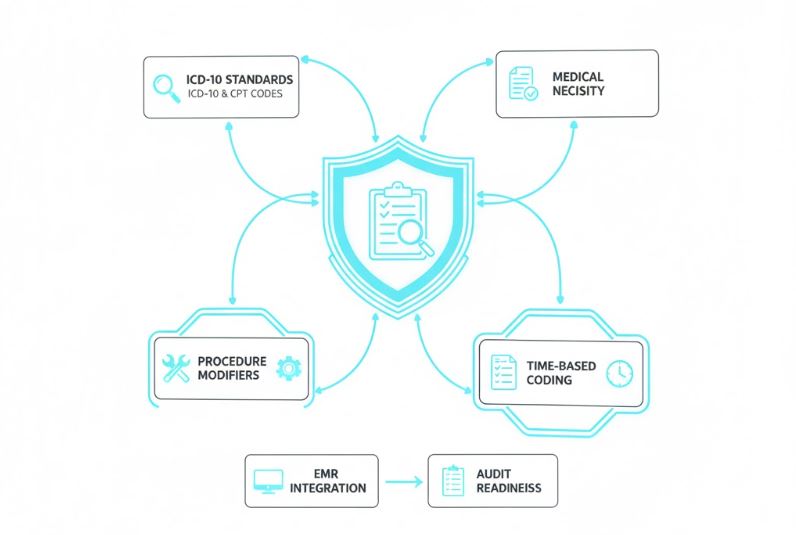
In the constantly changing realm of podiatry – upholding accurate and complaint billing methods is crucial for securing prompt payments, minimising claim rejections and guaranteeing compensation for services provided. As the healthcare environment evolves – podiatrists need to adapt to numerous changes in medical billing and coding to enhance revenue cycle management and ensure adherence to insurance and government regulations. A key element of precise billing in podiatry is thorough documentation, which serves as the basis for accurate coding and compensation
This guide explores the essential principles of recognising and improving for podiatrist billing by accurately recording the services rendered. Understanding the significance of comprehensive patient documentation along with the precise choice of CPT (current procedural terminology) and ICD 10 (International classification of diseases, Tenth revision) codes, will enable podiatrists to reduce mistakes, maintain compliance, and enhance their billing practices
- Accurate documentation: the foundation of proper billing
Accurate recording of services is essential for effective billing in podiatry. Even the most correct billing codes may result in inconsistencies or rejected claims if the data are not clear, succinct and comprehensive. Precise documentation guarantees that the services provided are thoroughly recorded, that medical necessity is explicitly demonstrated and that the procedure or service is supported by appropriate clinical rationale
- Comprehensive SOAP Notes
The SOAP (Subjective, Objective, Assessment, Plan) format is well known in medical documentation for developing thorough, structured patient records. All four elements are essential for accurate billing:
- Subjective: the patient’s history, grievances, and symptoms are documented in their own words in this part. This could involve foot pain, edema, or trouble walking in the context of podiatry
- Objective: this segment encompasses the clinical observations, consisting of vital signs, physical assessments, diagnostic evaluations, and all other quantifiable information pertinent to the patient’s status.
- Evaluation: the podiatrist will offer their clinical diagnosis informed by both subjective and objective observations.
- Plan: the treatment plan details the suggested approach, encompassing any procedures, therapies, or referrals. This part is especially crucial for assessing medical necessity and for identifying the correct coding.
By maintaining thorough SOAP notes, podiatrists establish a clear documentation that can be directly associated with the billing codes, minimizing confusion or possible audits
- Medical necessity
A crucial element of podiatrist documentation is the determination of medical necessity. Insurance companies, such as Medicare and Medicaid, along with private insurers, mandate that the services rendered are essential for diagnosing or treating a particular medical issue. The documentation should clearly indicate that the service was medically justified and that other treatment options were evaluated or dismissed. Lacking this, even accurately used CPT or ICD 10 codes could result in denials
For instance, if a patient is having a bunionectomy, the records must describe the pain, deformity, and effects on the patient’s quality of life, encompassing any unsuccessful conservative treatments. This validates the necessity of surgery and endorses billing for the operation
- Detailed descriptions of services
While documenting the services offered – make sure to include thorough descriptions of the procedures’. In podiatry, this can include surgical interventions, diagnostic evaluations and therapeutic measures. Comprehensive documentation must outline the location, nature of the procedure and any specifics of the service provided as these particulars directly influence the selected billing codes.
For instance, when carrying out a hammertoe correction, the records must encompass:
- Which toe received treatment (e.g., second toe)
- The technique for correction (e.g., soft tissue manipulation or joint consolidation)
- Any issues or specific factors to consider
The biller can choose the appropriate CPT codes and prevent claim denials because of ambiguity by giving precise, and unambiguous explanations
- Electronic health records (EHR) systems
The use of EHR systems can significantly improve the precision and productivity of medical records. EHRs offer templates, drop down options, and automated coding recommendations, assisting podiatrists in documenting their services consistently. The systems also guarantee that the appropriate codes are chosen according to the documentation provided minimizing the chances of human mistake. Additionally, EHRs’ frequently come with integrated features that facilitate clinical decision making and reminders, enhancing the standard of care and billing record accuracy
- Proper coding: selecting the right codes for accurate billing
After the documentation is established, the subsequent step involves choosing the appropriate CPT and ICD 10 codes. This is the point at which numerous mistakes can happen if the coder lacks a solid grasp of the procedures or diagnoses’ being recorded. Precise coding is essential for appropriate compensation.
- CPT codes: accuracy in procedure coding
CPT codes serve to denote the services or procedures rendered during a patient’s visit. In podiatry, these codes can vary from standard office appointments to intricate surgical procedures. For instance:
- CPT code 28296 denotes a bunionectomy which may include an osteotomy or not.
- CPT code 28270 is designated for the repair of hammertoe.
Selecting the appropriate CPT code must correspond with the details in the medical record, making precise documentation essential. Make certain that the selected code accurately represents the procedure carried out. Incorrect use of a CPT code can result in claim rejections or excess payments potentially leading to audits
- ICD 10 code: accurate diagnosis coding
ICT 10 codes are employed to categorize and code every diagnosis, symptom, and procedure documented alongside Healthcare services. Correctly choosing ICD 10 codes guarantees that the podiatrist’s diagnosis is accurately represented in the claim. Frequent ICD 10 codes for podiatry encompass:
- M21.211 – Bunion (hallux valgus), right foot
- M77.31 – right leg Achilles tendonitis.
- Z79.01– prolonged administration of aspirin.
Every diagnosis needs to be thoroughly recorded and the ICD 10 codes need to correspond with the condition’s severity and details as stated in the clinical notes’. Not adhering to this may lead to inaccurate claims resulting in postponed reimbursements or rejections
- Modifiers: clarifying and enhancing codes
Modifiers are essential for podiatric procedures because they offer extra information regarding the service provided. Modifiers can denote that a procedure was executed bilaterally (modifier 50), that a service was associated with prior surgery (modifier 79) or that a procedure was more complicated than normal (modifier 22). Correct application of modifiers’ guarantees that the bill is clear, concise, and representative of the care given
- Compliance and best practices: minimizing billing errors and audits
Alongside precise documentation and coding – podiatrists need to follow compliance regulations to prevent mistakes and audits. Non-compliance with the rules established by insurance companies’ and government organisations can lead to penalties or a loss of reimbursement.
- Routine audits and internal assessments
Performing consistent audits and internal assessments of coding practices guarantees that the clinic’s billing remains accurate and adheres to current regulations’. These audits must review patient records, coding precision, and the suitability of billing for services provided. Internal audits assist in pinpointing areas where documentation or coding may be insufficient and can be improved prior to external audits taking place
- Staying updated with coding guidelines
The most recent coding requirements from organisations’ such as the Centers for Medicare & Medicaid Services (CMS) and other insurance carriers must be followed by podiatrists. It’s important to keep up with any new codes, modifiers or payment regulations that can have an impact on podiatry treatments because coding guidelines might change often.
- Communication with patients and verification of insurance
Confirm patient insurance coverage and eligibility prior to delivering services. This phase guarantees that the patient’s plan will include the podiatric services offered and facilitates improvement of patient expectations concerning out of pocket costs. Clear communication with patients regarding their financial obligations will minimise billing disagreements and enhance patient satisfaction
- Training and education of staff
Ongoing training for employees on documentation, coding and billing processes is crucial. Ongoing education guarantees that both clinical and administrative personnel comprehend the subtleties of podiatric billing – from recording services to properly choosing the right codes
Final thoughts
Precise documentation in podiatrist billing is a complex process that includes detailed clinical notes, accurate coding and adherence to medical regulations. By concentrating on detailed documentation and remaining updates on coding best practices – podiatrists can guarantee that their billing procedures are effective, precise and adhere to industry regulations. These strategies not only reduce claim rejections but also enhance revenue cycle management – ultimately enabling podiatry practices to succeed in a competitive and regulated setting


