
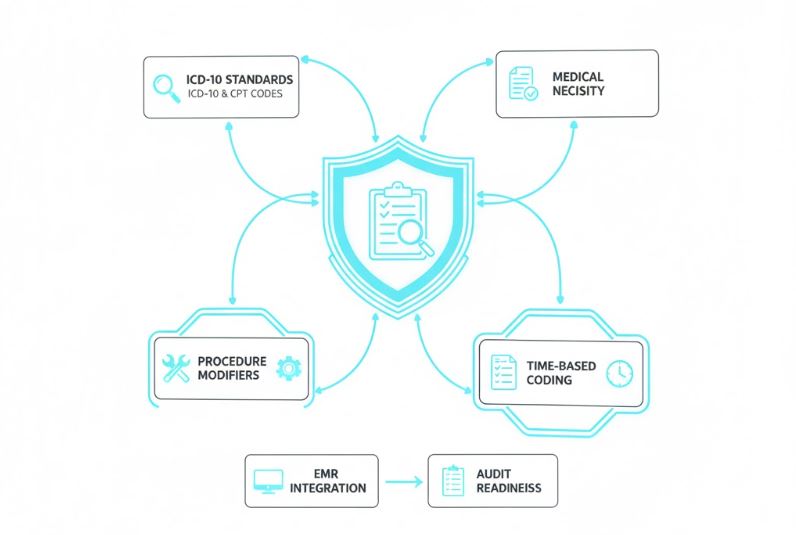
How to identify Podiatrist billing for accurately documenting services

podiarist

In the constantly changing realm of podiatry – upholding accurate and complaint billing methods is crucial for securing prompt payments, minimising claim rejections and guaranteeing compensation for services provided. As the healthcare environment evolves – podiatrists need to adapt to numerous changes in medical billing and coding to enhance revenue cycle management and ensure adherence to insurance and government regulations. A key element of precise billing in podiatry is thorough documentation, which serves as the basis for accurate coding and compensation

This guide explores the essential principles of recognising and improving for podiatrist billing by accurately recording the services rendered. Understanding the significance of comprehensive patient documentation along with the precise choice of CPT (current procedural terminology) and ICD 10 (International classification of diseases, Tenth revision) codes, will enable podiatrists to reduce mistakes, maintain compliance, and enhance their billing practices

  1. Accurate documentation: the foundation of proper billing 

Accurate recording of services is essential for effective billing in podiatry. Even the most correct billing codes may result in inconsistencies or rejected claims if the data are not clear, succinct and comprehensive. Precise documentation guarantees that the services provided are thoroughly recorded, that medical necessity is explicitly demonstrated and that the procedure or service is supported by appropriate clinical rationale

  1. Comprehensive SOAP Notes

The SOAP (Subjective, Objective, Assessment, Plan) format is well known in medical documentation for developing thorough, structured patient records. All four elements are essential for accurate billing:

  • Subjective: the patient’s history, grievances, and symptoms are documented in their own words in this part. This could involve foot pain, edema, or trouble walking in the context of podiatry 
  • Objective: this segment encompasses the clinical observations, consisting of vital signs, physical assessments, diagnostic evaluations, and all other quantifiable information pertinent to the patient’s status.
  • Evaluation: the podiatrist will offer their clinical diagnosis informed by both subjective and objective observations.
  • Plan: the treatment plan details the suggested approach, encompassing any procedures, therapies, or referrals. This part is especially crucial for assessing medical necessity and for identifying the correct coding. 

By maintaining thorough SOAP notes, podiatrists establish a clear documentation that can be directly associated with the billing codes, minimizing confusion or possible audits

  1. Medical necessity 

A crucial element of podiatrist documentation is the determination of medical necessity. Insurance companies, such as Medicare and Medicaid, along with private insurers, mandate that the services rendered are essential for diagnosing or treating a particular medical issue. The documentation should clearly indicate that the service was medically justified and that other treatment options were evaluated or dismissed. Lacking this, even accurately used CPT or ICD 10 codes could result in denials

For instance, if a patient is having a bunionectomy, the records must describe the pain, deformity, and effects on the patient’s quality of life, encompassing any unsuccessful conservative treatments. This validates the necessity of surgery and endorses billing for the operation

  1. Detailed descriptions of services 

While documenting the services offered – make sure to include thorough descriptions of the procedures’. In podiatry, this can include surgical interventions, diagnostic evaluations and therapeutic measures. Comprehensive documentation must outline the location, nature of the procedure and any specifics of the service provided as these particulars directly influence the selected billing codes.

For instance, when carrying out a hammertoe correction, the records must encompass:

  • Which toe received treatment (e.g., second toe)
  • The technique for correction (e.g., soft tissue manipulation or joint consolidation)
  • Any issues or specific factors to consider 

The biller can choose the appropriate CPT codes and prevent claim denials because of ambiguity by giving precise, and unambiguous explanations

  1. Electronic health records (EHR) systems 

The use of EHR systems can significantly improve the precision and productivity of medical records. EHRs offer templates, drop down options, and automated coding recommendations, assisting podiatrists in documenting their services consistently. The systems also guarantee that the appropriate codes are chosen according to the documentation provided minimizing the chances of human mistake. Additionally, EHRs’ frequently come with integrated features that facilitate clinical decision making and reminders, enhancing the standard of care and billing record accuracy

  1. Proper coding: selecting the right codes for accurate billing

After the documentation is established, the subsequent step involves choosing the appropriate CPT and ICD 10 codes. This is the point at which numerous mistakes can happen if the coder lacks a solid grasp of the procedures or diagnoses’ being recorded. Precise coding is essential for appropriate compensation.

  1. CPT codes: accuracy in procedure coding 

CPT codes serve to denote the services or procedures rendered during a patient’s visit. In podiatry, these codes can vary from standard office appointments to intricate surgical procedures. For instance: 

  • CPT code 28296 denotes a bunionectomy which may include an osteotomy or not.
  • CPT code 28270 is designated for the repair of hammertoe.

Selecting the appropriate CPT code must correspond with the details in the medical record, making precise documentation essential. Make certain that the selected code accurately represents the procedure carried out. Incorrect use of a CPT code can result in claim rejections or excess payments potentially leading to audits

  1. ICD 10 code: accurate diagnosis coding 

ICT 10 codes are employed to categorize and code every diagnosis, symptom, and procedure documented alongside Healthcare services. Correctly choosing ICD 10 codes guarantees that the podiatrist’s diagnosis is accurately represented in the claim. Frequent ICD 10 codes for podiatry encompass:

  • M21.211 – Bunion (hallux valgus), right foot 
  • M77.31 – right leg Achilles tendonitis.
  • Z79.01– prolonged administration of aspirin.

Every diagnosis needs to be thoroughly recorded and the ICD 10 codes need to correspond with the condition’s severity and details as stated in the clinical notes’. Not adhering to this may lead to inaccurate claims resulting in postponed reimbursements or rejections

  1. Modifiers: clarifying and enhancing codes

Modifiers are essential for podiatric procedures because they offer extra information regarding the service provided. Modifiers can denote that a procedure was executed bilaterally (modifier 50), that a service was associated with prior surgery (modifier 79) or that a procedure was more complicated than normal (modifier 22). Correct application of modifiers’ guarantees that the bill is clear, concise, and representative of the care given

  1. Compliance and best practices: minimizing billing errors and audits

Alongside precise documentation and coding – podiatrists need to follow compliance regulations to prevent mistakes and audits. Non-compliance with the rules established by insurance companies’ and government organisations can lead to penalties or a loss of reimbursement. 

  1. Routine audits and internal assessments 

Performing consistent audits and internal assessments of coding practices guarantees that the clinic’s billing remains accurate and adheres to current regulations’. These audits must review patient records, coding precision, and the suitability of billing for services provided. Internal audits assist in pinpointing areas where documentation or coding may be insufficient and can be improved prior to external audits taking place

  1. Staying updated with coding guidelines 

The most recent coding requirements from organisations’ such as the Centers for Medicare & Medicaid Services (CMS) and other insurance carriers must be followed by podiatrists. It’s important to keep up with any new codes, modifiers or payment regulations that can have an impact on podiatry treatments because coding guidelines might change often.

  1. Communication with patients and verification of insurance 

Confirm patient insurance coverage and eligibility prior to delivering services. This phase guarantees that the patient’s plan will include the podiatric services offered and facilitates improvement of patient expectations concerning out of pocket costs. Clear communication with patients regarding their financial obligations will minimise billing disagreements and enhance patient satisfaction

  1. Training and education of staff 

Ongoing training for employees on documentation, coding and billing processes is crucial. Ongoing education guarantees that both clinical and administrative personnel comprehend the subtleties of podiatric billing – from recording services to properly choosing the right codes

Final thoughts 

Precise documentation in podiatrist billing is a complex process that includes detailed clinical notes, accurate coding and adherence to medical regulations. By concentrating on detailed documentation and remaining updates on coding best practices – podiatrists can guarantee that their billing procedures are effective, precise and adhere to industry regulations. These strategies not only reduce claim rejections but also enhance revenue cycle management – ultimately enabling podiatry practices to succeed in a competitive and regulated setting

Injection & Pain Management

We provide compliant billing for foot injections, nerve blocks, and pain management procedures with accurate documentation and proper modifier usage.

Advanced Treatments

We handle advanced podiatric treatments with proper prior authorization management and comprehensive clinical documentation for high-value services.

Nail & Skin Procedures

We ensure accurate coding for nail debridement, callus removal, and skin lesion treatments with proper medical necessity justification and frequency compliance.

Surgical Procedures

We manage complex podiatric surgeries with accurate modifier usage, justified gaps between claims, and transparent timeframe documentation for all procedures.

Diabetic Care Management

We coordinate diabetic foot care services with proper medical necessity documentation and systematic condition correlation for comprehensive treatment.

Orthotic Services

We provide specialized billing for custom orthotics and devices, ensuring proper HCPCS and ICD-10 code pairing to justify fitting and delivery documentation.

Routine Care & Diagnostics

We handle routine foot care according to strict medical necessity criteria, ensuring precise paperwork and accurate coding for debridement and mycotic nail care, with proper frequency documentation.

Wound Care Partnerships

We provide accurate code coordination to prevent overlapping, ensure transparent tracking for pre- and post-surgical services, and deliver complete operative notes with reduced errors.

Graft & Skin Substitute Procedures

We select accurate application and graft codes based on location and wound size, audit surgical documents to ensure correct Q-code pairing for procedures and supplies, and assist in navigating state-specific Medicaid nuances through proactive prior authorization.

DME Billing

Robust compliance for orthotics, diabetic shoes, walking boots, and offloading devices. We ensure that certified coders are used for accurate coding and a perfect match for every claim. We evaluate the signature requirements of every payer and employ proactive strategies for expedited prior authorization.

Injection Therapies

We handle foot injection procedures with accurate MCO compliance, ensuring proper documentation and modifier usage for maximum reimbursement in the NY market.

Nail & Skin Care

We provide compliant billing for nail debridement and skin lesion procedures, meeting eMedNY-specific documentation requirements and ensuring proper medical necessity justification.

Advanced Treatments

We manage advanced podiatric treatments with NY-specific requirements, ensuring proper Q-code usage, comprehensive clinical packets, and expedited prior authorization processes.

Diabetic Care Management

We coordinate diabetic foot care services with wound care partnerships, ensuring proper documentation and transparent billing coordination for all involved providers.

Surgical Procedures

We handle complex podiatric surgeries with MCO coordination, ensuring accurate service sequencing and proper documentation to prevent overlapping claims and denials.

Orthotic Services

We provide specialized eMedNY-compliant orthotic billing with precise HCPCS coding, accurate ICD-10 pairing, and comprehensive modifier knowledge for maximum reimbursement.

Routine Care & Diagnostics

We ensure eMedNY compliance for routine foot care services with systematic condition documentation, proper modifier alignment, and comprehensive medical necessity justification for all procedures.

Graft & Skin Substitute Procedures

We prepare comprehensive clinical packages for fast approval, ensure thorough compensation for graft products and application, and prevent claims denials through accurate coding and correct submission.

Wound Care Partnerships

We provide accurate code coordination to prevent overlapping, ensure transparent tracking for pre- and post-surgical services, and deliver complete operative notes with reduced errors.

DME Billing

NY Medicaid’s top coverages include diabetic shoes and inserts, ankle-foot orthoses, braces, and custom-molded orthotics. We ensure eMedNY compliance through precise documentation, proper ICD-10 coding, and in-depth knowledge of modifiers to prevent denials.

Robotic Procedures

We deal with complex billing for radical prostatectomy, partial nephrectomy, and cystectomy by elaborative documents for the used devices. Our accurate codes and modifiers ensure successful approvals.

Telehealth

Our coders ensure accuracy for pre-op consultations, follow-ups, and LUTS/OAB management. Our optimized POS and use of modifiers have lower denial rates, as we demonstrate their necessity with clinical documents.

Urodynamics & Diagnostics:

We handle multi-channel involvement and billing complications with detailed CPT/ICD pairing. Our proactive prior authorization handling and expert claim structuring ensure error-free approvals.

Cystoscopy & Endoscopy:

We capture every detail and require evidence to ensure a smooth claim approval for office-based and hospital-based endoscopic procedures. We offer robust billing claims for biopsies and stone removals.

Lithotripsy (ESWL) & Stone Management:

We understand the complex bundling of ESWL, URS, and stone procedures, including device charges, anesthesia, and supplies for ongoing care. This in-depth knowledge ensures coding accuracy for each component.

Prostate Procedures & Biopsy:

We offer meticulous billing for targeted biopsies and imaging-guided prostate procedures, ensuring proper coordination of involved pathology and detailed capture of all allowable charges.

Implants & Prosthetics

We strictly follow the payer’s rules for high-value penile prostheses and testicular implants, ensuring proper coverage for device charges. Our coders ensure proper coding pairs, transparent vendor contracts, and logs for implants.

Pathology & Imaging

Our team possesses in-depth knowledge of the working principles of pathology and imaging centers. We collaborate with service providers to obtain accurate clinical information, ensuring that we capture all allowable charges.

Botox & Neuromodulation

For these complex services, we provide thorough coverage by handling prior authorization approvals and ensuring coding accuracy for both trial and permanent procedures. Our modifier’s accuracy provides high compliance with diverse payer requirements.

DME & Catheter Supplies:

We provide streamlined billing claims for catheter and drainage bag supplies, ensuring smooth and timely payment collections. Our proof-of-delivery and proactive SOPs save practices from financial loss.

DME & Catheters

We handle catheter supplies, ongoing maintenance claims, and billing for incontinence aids. We complete clinical documents with proof of need, supply evidence, and other supporting elements according to Medicaid requirements.

Pathology & Advanced Imaging

Outpatient labs and imaging services face facility-based billing cuts due to poor classification. We manage all complexities with professional splits and ensure compliant claims for radiology reads and pathology services.

Botox & Neuromodulation

We perfectly align the trial with a permanent implant and explain all stages with accurate codes. Our precise and error-free claim submission ensures maximum reimbursement for all elements.

Implants & Prosthetics

We offer support for commercial or Medicaid billing claims through transparent device tracking, fair vendor contracts, and compliant pre-auths, resulting in the successful implantation of penile prostheses, urinary sphincters, or slings.

Prostate Procedures & Biopsies

Pairing of biopsies with MRI-guided prostate means additional care for billing documents. These coordinated services required accurate pathology linking, ensuring that our robust component captures the necessary information.

Lithotripsy & Stone Procedures

We offer coding accuracy from ESWL to ureteroscopy by managing compliant documents for anesthesia, professional components, and prior authorization for such high-value services.

Cystoscopy & Endoscopic Interventions

Our technical expertise ensures billing accuracy for stent removals, cystoscopy, and facility-based endoscopy procedures. We separate each component of treatment to bring payment for all.

Urodynamics & Pelvic Testing

We justify the clinical necessity for urodynamic services. We offer hands-on support for authorization, ensure claims accuracy with diagnosis justifications, and document compliance for revisits.

Telehealth Evaluation Services

We have current information about eMedNY and MCO policies, ensuring coding accuracy with proper place-of-service designations, relevant modifiers, patient consent forms, and explanations of rendered services.

Robotic Procedures

We cover high-value procedures such as prostatectomy and nephrectomy, among others, by accurately documenting device costs in clinical documents and justifying their necessity under APG and facility-based insurance rules.

Pathology & Imaging Coordination

We resolve coding conflicts for these pairing services and ensure a justified coordination in documents to prepare a clean claim with reduced denial risks.

DME & Catheter Supply Managemen

The Medi-Cal and commercial payers have strict compliance requirements for DME. We streamline your claims with transparent usage tracking to ensure quality care and justified reimbursement.

Botox, Neuromodulation & OAB Treatments

We simplify the staged billing process for trials by managing prior authorization, the device’s paperwork, and submitting claims to accurate insurers to make it more manageable.

Implants & Prosthetics

We expedite your operation by handling authorization and vendor contracts, managing paperwork for pre-approvals, ensuring coordination, and maintaining inventory logs for stents and penile implants.

Prostate Procedures & Biopsies

Our experts accurately sequence the complex billing claims for MRI-fusion biopsies, prostate services, and imaging pairings across various payers to ensure maximum reimbursement for practices.

Lithotripsy & Stone Procedures

We navigate the complex process through accurate coding, transparent anesthesia reports, and the use of durable equipment, resulting in maximum coverage for every service.

Cystoscopy & Endoscopic Interventions

We capture each detail about scope procedures, stent placements, and biopsies performed in facility or ASC settings to prepare compliant claim documents.

Urodynamics & Pelvic Testing

We understand the unique compliance requirements, from bladder studies to pelvic floor testing, which prove the clinical necessity to ensure robust prior authorization and successful billing claims.

Telehealth Evaluation Services

California has broader telehealth services, with high Medi-Cal reimbursement for these services. We cover modality, consent, and explain facility settings so that you can get maximum advantage from every allowed charge.

Robotic Procedures

We precisely document robotic-assisted surgeries, negotiate with insurers, reflect the procedure’s complexity, and complete all paperwork in accordance with payer requirements to ensure a justified payment.

AB 72 – Surprise Billing Law

For podiatrists providing surgical services in out-of-network facilities, California’s AB 72 limits balance billing. Navigating this requires precise billing strategies.

Prior Authorization Hurdles


Increasingly, California payers require prior authorizations for DME, orthotics, skin grafts, and advanced wound care procedures. Failure leads to non-payment.

Workers’ Compensation Complications

California’s Workers’ Compensation system demands strict adherence to the Official Medical Fee Schedule (OMFS) and highly detailed documentation—especially for podiatric injury care, fracture management, and surgical interventions

Complex Wound Care & Skin Graft Billing

Podiatrists collaborating with wound care centers for diabetic ulcers, pressure sores, or limb salvage procedures face frequent denials related to skin substitute grafts (e.g., Apligraf®, Dermagraft®) and advanced wound treatments like NPWT (vacuum therapy).

Medi-Cal Restrictions

Medi-Cal limits podiatry services unless directly related to chronic disease management. Denials are common without proper coding and documentation.

Routine Foot Care Scrutiny

California insurers, including Medi-Cal and major HMOs (Kaiser, Blue Shield CA), often classify foot care (like nail debridement and callus removal) as non-covered unless medically justified by conditions like diabetes or peripheral vascular disease.